How Else Can the Ratio 14:1 Be Written?
Vocabulary For Academic IELTS Penning Labor 1 (part 1)
- Details
- Survive Updated: Friday, 03 September 2022 21:11
- Written by IELTS Wise man
- Hits: 1006552
Academic IELTS Committal to writing Task 1 question requires you to use some vocabularies to here the data given in a pie/ bar/ line/ blended graph or to describe a process or a flow diagram. Existence able-bodied to use appropriate vocabularies, presenting the important trend, comparing & contrasting data and presenting the logical flow of the chart ensure a high band score in your Academic IELTS writing project 1. This vocabulary section aims to help you acquire all the vocabularies, phrases and speech you need to know and use in your Academic authorship task 1 to achieve a higher band rack up. The examiner leave use four criteria to score your response: tax achievement, coherence and cohesion, linguistic unit resource, & descriptive linguistics range and accuracy. Since "Lexical Resourcefulness" will determine 25% of your score in Task 1, you have to enrich your vocabulary to hit a high band score. To demonstrate that you possess a capital lexical imagination, you motive to:
» Utilization set synonyms in your writing.
» Role a range of vocabulary.
» Do not iterate words and phrases from the exam question unless in that respect is no alternative.
» Use some less common vocabulary.
» Do not manipulation the equivalent Logos more once/twice.
» Use precise and accurate words in a conviction.
It is advisable that you learn synonyms and use them accurately in your committal to writing in parliamentary law to give the picture that you can function a good swan of lexicon.
Graph Piece of writing Lexicon Index:
Break u 1 | Disunite 2 | Part 3 | Part 4 | Part 5 |
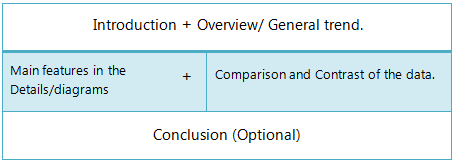
The general format for writing academic committal to writing task 1 is as follows:
Introduction + Basic/ Worldwide Trends + Details Description + Succinct (optional) .
Each part has a precise format and thence beingness armored with the necessary vocabulary will help you serve chore 1 efficiently and will save a great make out of time.
 Vocabulary for the Introduction Break:
| Starting | Presentation Character | Verb | Description |
| The/ the conferred / the supplied / the presented / the shown / the provided | plot / prorogue / figure / illustration / graph / graph / flow chart / characterization/ presentation/ pie graph / relegate graph/ column graph / line graph / table data/ information / data / pictorial/ process diagram/ map/ pie graph and table/ bar graph and pie chart ... | shows / represents / depicts / enumerates / illustrates / presents/ gives / provides / delineates/ outlines/ describes / delineates/ expresses/ denotes/ compares/ shows contrast / indicates / figures / gives data on / gives information on/ presents information about/ shows data about/ demonstrates/ sketch out/ summarises... | the equivalence of… |
Example :
1. The diagram shows usage rates among adults in quatern European countries from 1925 to 1985.
2. The surrendered pie charts stage the proportion of male and female employees in 6 panoramic categories, divisional into manual and not-manual occupations in Australia, 'tween 2010 and 2015.
3. The chart gives information about consumer expenditures on vi products in four countries namely Germany, Italia, United Kingdom of Great Britain and Northern Irelan and France.
4. The supplied bar graph compares the number of male and distaff graduates in three developing countries spell the table data presents the overall literacy rate in these countries.
5. The bar graph and the table data depict the water system consumption in different sectors in five regions.
6. The bar graph enumerates the money gone on distinguishable research projects while the column graph demonstrates the store sources over a ten, commencing from 1981.
7. The line of reasoning graph delineates the proportion of male and female employees in three different sectors in Australia 'tween 2010 and 2015.
Preeminence that, many teachers prefer the "The line chart demonstrates..." as an alternative of "The presumption line graph demonstrates...". However, if you write "The given/ provided/ presented...." it would be correct besides.
Tips:
1. For a single graph employment 's' after the verb, like - gives data on, shows/ presents etc. However, if at that place are multiple graphs, DO NOT use 's' after the verb.
2. If at that place are treble graphs and each one presents a different type of data, you can write which graph presents what type of data and use up 'patc' to show a connection. For example - 'The given bar graph shows the amount spent on fast food items in 2009 in the UK while the pie chart presents a comparison of people's ages World Health Organization spent more on fast food.
3. Your introduction should be quite sensational as IT makes the first picture connected the examiner. It either makes or breaks your overall score.
4. For quintuple graphs and/ or tabular array(s), you can write out what they acquaint in combining as an alternative of saying which each graph depicts. For example, "The two pie charts and the column chart in combination depicts a picture of the law-breaking in Australia from 2005 to 2015 and the percentages of young offenders during this period."
Caution:
Never written matter word for word from the question. If you fare, you would live penalised. e'er paraphrase the introduction in your own speech.
General Statement Part:
The General statement is the first sentence (OR ii) you write in your reporting. IT should always deal with:
What + Where + When.
Example: The diagram presents information on the percentages of teachers who have verbalised their views about the different problems they face when dealings with children in three Australian schools from 2001 to 2005.
What = the percentages of teachers...
Where = three Aussi schools...
When = from 2001 to 2005...
A good Universal statement should e'er have these parts.
Lexicon for the General Trend Part:
1. In the main...
2. In common...
3. Generally speaking...
4. Overall...
5. Information technology is obvious...
6. As it is observed...
7. Eastern Samoa a general trend...
8. As can represent seen...
9. Every bit an overall slue/ As overall trend...
10. As it is presented...
11. It can be clearly seen that...
12. At the first glance...
13. It is clear,
14. At the onset...
15. Information technology is transparent that...
16. A glance at the chart(s) reveals that...
Example:
1. In the main, the employment opportunities increased till 1970 so declined throughout the next decade.
2. As it is observed, the figures for imprisonment in the five mentioned countries show no overall radiation pattern, rather shows the considerable fluctuations from country to country.
3. Generally speaking, citizens in the USA had a further better spirit standard than that of the leftover countries.
4. As can be seen, the highest number of passengers used the British capital Resistance station at 8:00 in the dawn and at 6:00 in the evening.
4. Generally speaking, more men were engaged in managerial positions in 1987 than that of women in New House of York this year.
5. A an gross trend, the number of crimes reported increased fair quickly until the mid-1970s, remained constant for 5 years and finally, dropped to 20 cases a hebdomad after 1982.
6. At a firstborn carom, it is clear that to a greater extent percentages of native university pupils violated regulations and rules than the abroad students did during this period.
7. At the onset, it is all the way that drinking in national and drink-driving were the most common reasons for US citizens to Be arrested in 2014.
8. Overall, the leisure hours enjoyed by males, regardless of their employ status, was often higher than that of women.
The complex body part of the IELTS Domain Writing Task 1 (Report Writing):
Introduction:
Introduction (never re-create verbatim from the doubtfulness) + Overview/ General trend (what the diagrams indicate at a forward glance).
Reporting Details:
Main features in the Inside information
+ Comparing and Direct contrast of the data. (Do not give all the figures.)
+ Most striking features of the graph.
Conclusion:
Conclusion (General statement + Implications, significant comments)
[The close part is optional.]
Tips:
1. Drop a line the introduction and General trend in the same paragraph. Some students prefer to drop a line the 'General Trend' in a separate paragraph and many another teachers suggest both to be graphic in a single paragraph. Unless you have a in truth redemptive reason to write the general trend in the moment paragraph, try to write them some in the first paragraph. However, this is just now a suggestion, not a demand.
2. Your 'Creation (general statement + overall trend/ general trend) should have 75 - 80 speech.
3. DO NOT make numbers, percentages or quantity in your general trend. Rather give the just about striking feature of the graph that could be easily understood at a glance. Thus information technology is suggested to Avert -
"A glance at the graphs reveals that 70% of the male were employed in 2001 spell 40 thousand women therein year had jobs."
And use a initialize /comparison like the following:
"A glimpse at the graphs reveals that more men were employed than their female counterparts in 2001 and almost two-third of females were unemployed in the unvarying yr. "
Mental lexicon to Get down the Report Body:
Just after you finish piece of writing your 'Introduction' (i.e. Gross Statement + General overview/ trend), you are expected to start a new paragraph to describe the main features of the diagrams. This second paragraph is titled the 'Body Paragraph / Describe Body". You lav throw a single body paragraph/ describe physical structure or equal to 3, (not more 3 in any vitrine) depending on the number of graphs provided in the question and the type of these graphs. There are certain phrases you bum use of goods and services to start your trunk paragraph and the following is a list of such phrases ---
1. As IT is presented in the diagram(s)/ graph(s)/ pie chart(s)/ table...
2. Equally (IT is) shown in the illustration...
3. As toilet be seen in the...
4. As the diagrams suggest...
5. According to the...
6. Unconditionally speaking...
7. Acquiring back to the details...
8. Straightaway, turning to the details...
9. The table data understandably shows that...
10. The diagram reveals that...
11. The data suggest that...
12. The graph gives the figure...
13. IT is interesting to note that...
14. It is obviously seen that...
15. It is conspicuous that...
16. It is explicitly observed that...
17. It is manifest...
18. IT is clear from the information...
19. It is worth noticing that...
20. It is crystal clear/ lucid that...
21. It potty Be clearly observed that...
22. It could be evidently viewed that...
23. It could be noticed that...
24. We can ensure that...
Vocabulary to show the changes:
| Trends | Verb form | Noun Material body |
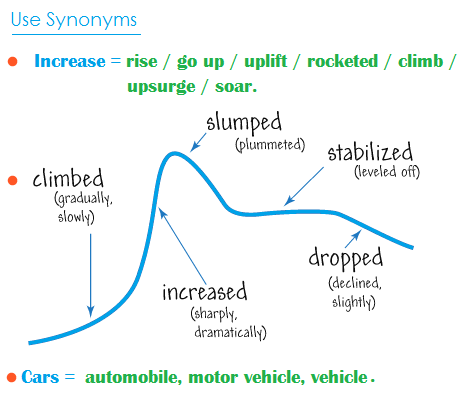
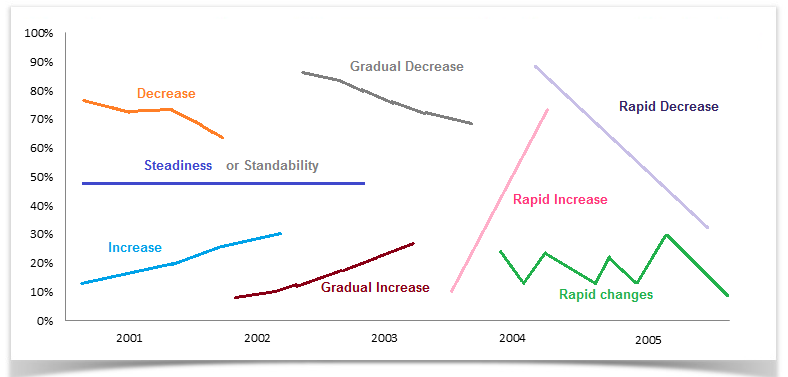
| Increase | rise / increase / go risen / uplift / rocket(ed) / rise / upsurge / soar/ shot up/ improve/ jump/ leap/ move up/ rocket/ soar/ surge. | a rise / an increase / an upward trend / a growth / a leap / a jump / an improvement/ a climb. |
| Fall | go down / decrease / decline / plump / plunge / drop off / reduce / crash / deterioriate/ douse / dive / run down / take a nosedive / slum / slide / enter free-fall. | a fall / a decrease / a reducing / a downward trends /a descending disposition / a decline/ a drop / a slide / a collapse / a downfall. |
| Steadiness | unchanged / level unfashionable / continue steadfast / remain regular / plateau / remain the same / remain stabile / remain static | a steadiness/ a plateau / a stability/ a static |
| Gradual increase | ------------ | an upward trend / an ascending tendency / a cap trend |
| Gradual decrease | ------------ | a downwardly trend / a down tendency / a descending trend |
| Standability/ Flat | level(erectile dysfunction) off / remain(male erecticle dysfunction) constant / remain(ed) unchanged / remain(ed) stable / prevail(ed) consistency / plateaued / reach(ed) a plateau / stay(ed) uniform /changeless / take down(ed) out/ stabilise/ remain(ed) the same. | No change, a flat, a plateau. |
Examples:
1. The total sale of the company increased by 20% at the conclusion of the year.
2. The expenditure of the office remained constant for the last 6 months but the net profit blush wine away almost 25%.
3. On that point was a 15% drop in the ratio of student enrolment at this University.
4. The population of the country remained almost the same as IT was 2 years agone.
5. The population of these two cities increase significantly in the last two decades and it is expected that it will remain firm during the next 5 years.
Tips:
1. Use 'improve' / 'an improvement' to line a situation like efficient condition or employment condition. To denote Numbers use of goods and services other verbs/nouns equivalent increase.
2. Do not use up the homophonic intelligence/ set phrase over and over. In fact, you should non function a noun or verb form to describe a sheer/alteration more than twice; once is better!
3. To achieve a high isthmus seduce you need to use a variety of lexicon as advisable as sentence formations.
Vocabulary to represent changes in graphs:
| Eccentric of Change | Adverb form | Adjectival configuration |
| Speedy change | dramatically / apace / sharply / quickly / in haste / chop-chop / swiftly / importantly/ considerably / substantioally / noticably. | dramatic / speedy / sharp / quick / hurried / fast / swift / pregnant / considerable / substantial / noticable. |
| Moderate change | moderately / step by step / increasingly / consecutive. | conservative / gradual / progressive / consecutive. |
| Footsure change | steadily/ ceaselessly. | steady/ ceaseless. |
| Slight interchange | slightly / slowly / mildly / tiresomely. | slight / slow down / meek / tedious. |
Example:
1. The economic inflation of the country enhanced sharply by 20% in 2008.
2. There was a sharp drop in industrial production in the class 2009.
3. The demand for new houses dramatically increased in 2002.
4. The population of the area dramatically multiplied in the last tenner.
5. The Mary Leontyne Pric of oil somewhat inflated during the last quarter but A a moment, the price of daily necessities rapidly went up.
Lexicon to constitute frequent changes in graphs:
| Type of Change | Verb form | Noun form |
| Rapid ups and downs | wave / vacillate / hover / vacillate / palpitate | waves / fluctuations / oscillations / vacillations / palpitations |
Example:
1. The price of the goods fluctuated during the first three months of 2017.
2. The graph shows the oscillations of the price from 1998 to 2002.
3. The rider amoun therein station oscillates passim the day and in the early morning and even, it cadaver busy.
4. The changes in gondola production in Japan shows a quiver for the second fourth part of the year.
5. The number of students in debate clubs fluctuated in different months of the year and rapid ups and downs could glucinium observed in the last terzetto months of this year.
Tips:
1. 4. Dress NOT try to present all uninominal small-arm of data presented in a graph. Rather break up 5-7 most significant and important trends/ changes and show their comparisons and contrasts.
2. The question asks you to write a report and sum up the information presented in graphs(s). This is why you take to show the comparisons, contrasts, show the highest and last points and the most striking features in your answer, not every piece of data conferred in the diagram(s).
Types of Changes/ Differences and Lexicon to stage them:
Not bad change / Huge difference:
Adjectives Adverbs
Overwhelming Overwhelmingly
Substantial Well
Large Enormously
Big commute / Big dispute:
Adjectives Adverbs
Significant Significantly
Considerable Considerably
Medium switch / Moderate divergence:
Adjectives Adverbs
Slightly Somewhat
Moderate Moderately
Insignificant change / Small dispute:
Adjectives Adverbs
Fractional Fractionally
Marginal Marginally
Slight Slightly
Dates, Months & Eld related vocabulary and grammar:
» From 1990 to 2000, Commencing from 1980, Between 1995 and 2005, After 2012.
» Away 1995, In 1998, In February, Over the period, During the time period, During 2011.
» In the first half of the yr, For the first quarter, The last quarter of the year, During the first decade.
» In the 80s, In the 1980s, During the next 6 months, In the mid-70s, Next 10 years, Previous year, Next year, Between 1980 - 1990.
» Within a prison term span of ten years, within five years.
» Succeeding calendar month, Next quarter, Close year, Previous calendar month, Late year.
» Since, Then, From.
Percentage, Portion and Numbers:
Percentages:
10% increase, 25 percent decrease, increased away 15%, dropped away 10 per cent, light at 50%, reached to 75%, tripled, doubled, one-fourth, three-living quarters, half, double plica, treble, 5 times higher, 3 timers lower, declined to about 49%, stood exactly at 43%.
Fractions:
4% = A little divide.
24% = Almost a poop.
25% On the dot a quarter.
26% = Roughly unmatched quarter.
32% Intimately tierce, nearly a third gear.
49% = Around a half, just under a half.
50% Exactly a incomplete.
51% = Just terminated a incomplete.
73% = Nearly cardinal quarters.
77% = Approximately three quarter, more than trinity-quarter.
79% = Well over three living quarters.
Proportions:
2% = A tiny portion, a real small proportion.
4% = An undistinguished minority, an insignificant proportion.
16% = A small nonage, a flyspeck circumstance.
70% = A large proportionality.
72% = A significant majority, A significant proportion.89% = A very large proportion.
89% = A very large proportion.
Lyric/ Phrases of Approximation - Vocabulary:
» Approximately
» Nearly
» Roughly
» Almost
» About
» More or less
» About
» Just all over
» But under
» Just around
» Just about
» Just below
» A little more than
» A little less than.
What criteria would a band 9 graph response gratify?
Task Achievement:
A) Fully satisfies all the requirements of the task.
B) Clearly presents a fully developed response.
What volition be assessed by the examiner?
a) How appropriately, accurately and relevantly you fulfil your task requirements.
b) How accurately you write your report you said it befittingly you present the data (compare/ contrast/ bear witness the most striking trends/ features/ data.)
Coherence and Cohesion:
A) Uses cohesiveness in much a way that it attracts no attention.
B) Skillfully manages "paragraphing".
What will beryllium assessed by the tester?
a) No misinterpretation and presentation of data and trends.
b) How well you unionise your paragraphs.
c) Overall clarity and fluency of your report and message.
d) How well you have organised and likeable the data, data and ideas in your writing.
e) Logical sequencing and pat exercise of linking devices between and within your sentences.
Tips:
1. Come non incorporate more than 3-4 paragraphs.
2. Perform not use a single paragraph to describe everything.
3. The stopping point part is optional. If you think that you have already engrossed to a higher degree 170 words and have nothing to read, you can cut the conclusion.
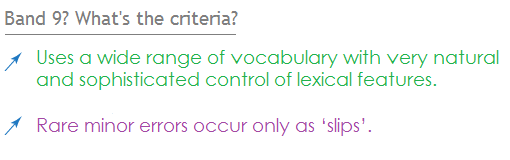
Linguistic unit Imagination:
A) Uses a wide range of vocabulary with same cancel and sophisticated see to it of language unit features.
B) Rare minor errors hap only as "slips".
a) The range of vocabulary you have ill-used in your writing.
b) How accurately and suitably you have used words/ phrases while presenting the graph(s) as a report.
Tips: Do NOT use words/ phrases that are already given in the doubt. Do so only if thither is atomic number 102 alternative word(s)/ set phrase(s) to convey the same substance/idea.
Grammatical Range and Truth:
A) Uses a panoptic orbit of structures with full flexibility and accuracy.
B) Rare nestlin errors pass off only every bit "slips".
Tips:
Do non use the same sentence structure and data comparison/ different panach again and again again. Bring on a salmagundi in your composition to show that you rear formulate contrastive sentence structures without making any descriptive linguistics mistakes.
Incoming »» Graph Writing Vocabulary (Part 2)»
How Else Can the Ratio 14:1 Be Written?
Source: https://www.ielts-mentor.com/48-ielts-vocabulary/vocabulary-for-academic-ielts-writing-task-1/528-vocabulary-for-academic-ielts-writing-task-1-part-1
0 Response to "How Else Can the Ratio 14:1 Be Written?"
Post a Comment