In Art the Buddha Is Typically Portrayed With Both Masculine and Feminine Qualities
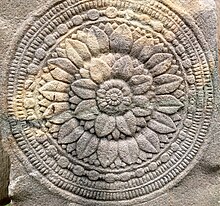
Lotus motif from Sanchi complex

An "Indra Post" at Sanchi
Buddhist symbolism is the use of symbols (Sanskrit: pratīka) to represent sure aspects of the Buddha's Dharma (educational activity). Early on Buddhist symbols which remain important today include the Dharma wheel, the Indian lotus, the 3 jewels and the Bodhi tree.[ane]
Anthropomorphic symbolism depicting the Buddha (besides as other figures) became very pop around the start century CE with the arts of Mathura and the Greco-Buddhist fine art of Gandhara. New symbols continued to develop into the medieval menstruation, with Vajrayana Buddhism adopting further symbols such as the stylized double vajra. In the modern era, new symbols similar the Buddhist flag were too adopted.
Many symbols are depicted in early Buddhist fine art. Many of these are ancient, pre-Buddhist and pan-Indian symbols of auspiciousness (mangala).[two] According to Karlsson, Buddhists adopted these signs because "they were meaningful, important and well-known to the majority of the people in Bharat." They as well may have had apotropaic uses, and thus they "must take been a fashion for Buddhists to protect themselves, just likewise a way of popularizing and strengthening the Buddhist movement."[3]
At its founding in 1952, the World Fellowship of Buddhists adopted 2 symbols to represent Buddhism.[4] These were a traditional eight-spoked Dharma wheel and the 5-colored flag.
Early Buddhist symbols [edit]
The primeval Buddhist fine art is from the Mauryan era (322 BCE – 184 BCE), there is piffling archeological evidence for pre-Mauryan period symbolism.[5] Early Buddhist art (circa 2nd century BCE to 2nd century CE) is commonly (merely not exclusively) aniconic (i.e. lacking an anthropomorphic image), and instead used various symbols to describe the Buddha. The best examples of this aniconic period symbolism can exist found at sites similar Sanchi, Amaravati, Bharhut, Bodhgaya and Sarnath.[6] Co-ordinate to Karlsson, three specific signs, the Bodhi tree, the Dharma wheel, and the stupa, occur frequently at all these major sites and thus "the earliest Buddhist cult practice focused on these 3 objects".[seven]
Among the primeval and most common Buddhist symbols institute in these early Buddhist sites are the stupa (and the relics therein), the Dharma wheel, the Bodhi Tree, the triratna (3 jewels), the vajra seat, the lotus flower, and the Buddha footprint.[eight] [i] [ix] [half-dozen] Several animals are too widely depicted, such as elephants, lions, nāga and deer.[8] Contemporary Buddhist art contains numerous symbols, including unique symbols not found in early Buddhism.
Gallery [edit]
-

A Dharmachakra being revered
-

Pinnacles from Bharhut depicting Dharmawheels and Lotus roundels
-

Illustrations from Sanchi, depicting a dharma chakra, devotees, and deer
-
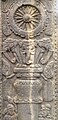
Dharmachakra, and elephants
-
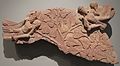
Bodhi tree showing distinctive centre-shaped leaves and devas
-
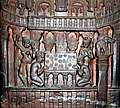
Relief of the Diamond Throne (Vajrasana) with ii triratnas
-
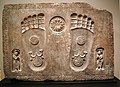
Buddhapada decorated with lotus roundels, Triratna'due south and swastikas, 2nd century, Gandhara
-

Buddhapada with other symbols
-
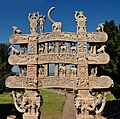
Carved decorations on the doorway of Sanchi stupa, note the dharma chakra, various animals, and Triratna (with srivasta in the center).
-

Empty throne and bodhi tree
-
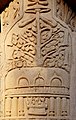
Bodhi tree with garlands, an umbrella, and Triratna's
-

The Buddha turning the dharma cycle at deer park
-

The Buddha'southward horse, Kanthaka, and an attendant with a chakra (royal umbrella)
-

Delineation of the dream of Maya (Buddha'southward mother), in which the Buddha enters her side as a white elephant, from Bharhut
-

A Pillar depicting an empty throne, the Naga male monarch Mucalinda and the Bodhi tree
-

A Naga at Sanchi
-
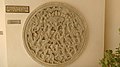
A depiction of devas property upwards the begging bowl of Buddha.
Southeast Asian Buddhist symbols [edit]
Theravada Buddhist fine art is strongly influenced by the Indian Buddhist art styles like the Amaravati and Gupta styles.[x] Thus, Theravada Buddhism retained near of the classic Indian Buddhist symbols such as the Dharma wheel, though in many cases, these symbols became more elaborately decorated with gold, jewels and other designs.
Dissimilar artistic styles also developed throughout the Theravada world equally well equally unique means of depicting the Buddha (such as the Thai style and the Khmer style) containing their own ways of using Buddhist symbols.
Gallery [edit]
-

Dhamma cycle and deer from Dvaravati
-

Dhamma bike, Dvaravati period, Khao Klang Nai, Si Thep Historical Park, Thailand
-

A Thai Dhamma wheel at Wat Phothivihan, Tumpat, Kelantan
-

Dhamma wheel at Wat Maisuwankiri, Tumpat, Malaysia
-

Dhamma wheel at
-

A mold and a Bai Sema stone (monastery purlieus stone)
-
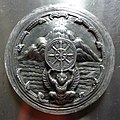
-
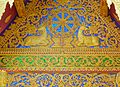
Dhammacakka on Main Gable, Wat Phra Putthabat Tak Pha, Lamphun
-

A Thai mode Dhamma wheel
-

Buddha Left Footprint, Wat Phra That Doi Suthep, Chiang Mai
-

Burmese Pali manuscript depicting a hamsa bird.
-

Lion in a Burmese Pali Manuscript
East Asian Buddhist symbols [edit]
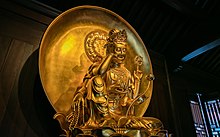
Statue of Guanyin with various attributes (cintamani, chakra, lotus, prayer beads)
E Asian Buddhism adopted many of the classic Buddhist symbolism outlined above. During the Tang dynasty (618–907 CE) Buddhist symbolism became widespread, and symbols like the swastika and the Dharma wheel (Chinese: 法輪; pinyin: fălún, "wheel of life") became well known in Prc. There were as well more than elaborate symbols, like Buddhist mandalas and complex images of Buddhas and bodhisattva figures.[11]
At that place are also some symbols that are generally unique to East Asian Buddhism, including the purple robe(which indicated a specially eminent monastic), the ruyi scepter, the "wooden fish", the ring staff (khakkhara), The Eighteen Arhats (or Luohan) (Chinese: 十八羅漢)the "ever burning lamp" (changmingdeng) and various kinds of Buddhist amulets or charms, such as Japanese omamori and ofuda, and Chinese fu (符) or fulu.[12] [xiii] [fourteen]
Chinese Buddhism also adopted traditional pre-Buddhist Chinese symbols and deities, including money trees, Chinese dragons, and Chinese gods like the Jade emperor and diverse generals like Guan Yu.[15] [16] Japanese Buddhism also developed some unique symbols of its own. For case, in Japanese Zen, a widely used symbol is the ensō, a hand-drawn black circumvolve.[17]
Gallery [edit]
-

Chinese Buddhist priest'southward silk robe with various Buddhist symbols
-

A statue of bodhisattva Kṣitigarbha belongings a cintamani stone and a ring staff
-

The Flaming Sword of Wisdom
-
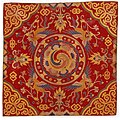
Bhutanese throne embrace with a gankyil
-

Old flag of Sikkim with Dharma wheel and gankyil
-
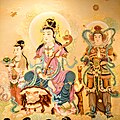
Chinese depiction of Manjushri, riding a king of beasts and holding a ruyi scepter
-

A japanese painting of Manjushri (monju) holding a sword and a lotus topped with a sutra, Kamakura period
-

-

Bodhidharma is widely depicted in Zen, the moon symbolizes enlightenment
-
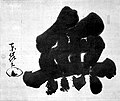
Calligraphy of the kanji for Mu (無, "no", "non") widely used in Zen calligraphy
-

Bronze finial of a monk's ring staff (shakujō), Nihon
-

A portrait of Zen monk Ingen property a wooden staff and a wing-whisk
Vajrayana Buddhist symbols [edit]

Five esoteric ritual objects from Japan including vajras, knife and bell.
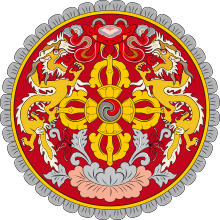
A viśvavajra or "double vajra" appears in the emblem of Bhutan
Mantric Buddhism (Guhyamantra, "Underground Mantra") or Vajrayana has numerous esoteric symbols which are not common in other forms of Buddhism.
The vajra is a primal symbol in Vajrayana Buddhism. It represents indestructibility (like a diamond), emptiness also as power (similar a thunder bolt, which was the weapon of the Vedic god Indra). According to Beer, it represents "the impenetrable, imperishable, immovable, immutable, indivisible, and indestructible land of absolute reality, which is the enlightenment of Buddhahood."[eighteen] The vajra is frequently paired with a bell (vajra-ghanta), which represents the feminine principle of wisdom. When paired together, they represent the perfect matrimony of wisdom or emptiness (bell) and method or skilful means (vajra).[19] There is likewise what is called the "crossed vajra" (vishva-vajra), which has four vajra heads emanating from a central hub.[20]
Other tantric ritual symbols include the ritual knife (kila), tantric staff (khatvanga), the skull cup (kapala), the flaying pocketknife (kartika), hand drum (damaru) and the thigh bone trumpet (kangling).[21]
Other Vajrayana symbols popular in Tibetan Buddhism include the bhavacakra (bicycle of life), mandalas, the number 108 and the Buddha eyes (or wisdom eyes) commonly seen on Nepalese stupas such as at Boudhanath.
There are various mythical creatures used in Vajrayana art as well: Snowfall Panthera leo, Wind Horse, dragon, garuda and tiger. The popular mantra "om mani padme hum" is widely used to symbolize compassion and is ordinarily seen inscribed on rocks, prayer wheels, stupas and fine art. In Dzogchen, the mirror is i of import symbol of rigpa.
Tibetan Buddhist architecture [edit]

8 types of Tibetan stupas
Tibetan Buddhist compages is centered on the stupa, called in Tibetan Wylie: mchod rten, THL: chörten. The chörten consists of v parts that represent the mahābhūta (5 elements). The base of operations is square which represents the earth chemical element, above that sits a dome representing water, on that is a cone representing burn, on the tip of the cone is a crescent representing air, inside the crescent is a flame representing ether. The tapering of the flame to a point can too be said to represent consciousness every bit a sixth element. The chörten presents these elements of the body in the lodge of the procedure of dissolution at death.[22]
Tibetan temples are oftentimes three-storied. The iii can represent many aspects such as the Trikaya (three aspects) of a Buddha. The ground story may have a statue of the historical Buddha Gautama and depictions of Earth and then represent the nirmāṇakāya. The first story may have Buddha and elaborate ornamentation representing rising to a higher place the human condition and the sambhogakāya. The 2nd story may have a primordial Adi-Buddha in Yab-Yum (sexual wedlock with his female counterpart) and be otherwise unadorned representing a return to the accented reality and the dharmakāya "truth body".[22]

Colour in Tibetan Buddhism [edit]
In Tibetan Buddhist art, various colors and elements are associated with the v Buddha families and other aspects and symbols:[22] [23] [24]
| Color | Symbolises | Buddha | Direction | Element | Transforming effect | Syllable |
|---|---|---|---|---|---|---|
| White | Purity, primordial being | Vairocana | East (or, in alternate organisation, North) | Water | Ignorance → Sensation of reality | Om |
| Green | Peace, protection from harm | Amoghasiddhi | North (or n/a) | Sky | jealousy → Accomplishing pristine awareness | Ma |
| Xanthous | Wealth, beauty | Ratnasaṃbhava | S (or Westward) | World | Pride → Awareness of sameness | Ni |
| Blue (low-cal and dark) | Knowledge, dark bluish also enkindling/enlightenment | Akṣobhya | Middle (or northward/a) | Air | Anger → "Mirror-like" sensation | Pad |
| Blood-red | Honey, compassion | Amitābha | W (or Due south) | Burn down | Attachment → Discernment/ discrimination | Me |
| Black | Death, death of ignorance, enkindling/enlightenment | – | n/a (or East) | Air | Hum |

The v colors (Sanskrit pañcavarṇa – white, light-green, yellow, bluish, red) are supplemented by several other colors including black and orange and golden (which is commonly associated with yellow). They are commonly used for prayer flags too as for visualizing deities and spiritual energy, structure of mandalas and the painting of religions icons.
Indo-Tibetan visual art [edit]
Indo-Tibetan Buddhism visual art contains numerous esoteric figures and symbols. There are dissimilar types of visual art in Indo-Tibetan Vajrayana. Mandalas are genre of Buddhist art that contains numerous symbols and images in a circumvolve and are an important element of tantric ritual. Thangkas are material paintings which are commonly used throughout the Indo-Tibetan Buddhist world.
Tibetan Buddhist deities may oft assume different roles and are thus drawn, sculpted and visualized differently co-ordinate to these roles. For case, Green Tara and White Tara which are dissimilar aspects of Tara that have unlike meanings. Greenish Tara is associated with protecting people from fear while the White Tara is associated with longevity. Shakyamuni Buddha may be seen in (pale) yellow or orange peel and Amitabha Buddha is typically red. These deities may also hold various attributes and implements in their easily, similar flowers, jewels, bowls and sutras. Depictions of "wrathful deities" are frequently very fearsome, with monstrous visages, wearing skulls or bodily parts. They also may carry all sorts of weapons or trigger-happy tools, like tridents, flaying knives and skull cups. The fierceness of these deities symbolizes the fierce free energy needed to overcome ignorance.[22]
Vajrayana Buddhism oftentimes specifies the number of feet of a Buddha or bodhisattva. While 2 is common there may too be x, sixteen, or twenty-4 feet. The position of the anxiety/legs may also have a specific significant such every bit in Green Tara who is typically depicted every bit seated partly cross-legged but with one leg down symbolising "immersion within in the absolute, in meditation" and readiness to pace forth and help sentient beings by "engagement without in the world through compassion".[22]
Gallery [edit]
-
-

-

In Tibetan Dzogchen thought, rigpa is symbolized past the white A inside of a circular rainbow.
-

-

State emblem of Mongolia with windhorse, iii jewels and dharma cycle
-

White elephant with mani (jewels)
-
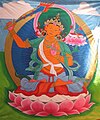
Manjushri with the flaming sword symbolizing prajna (wisdom).
-
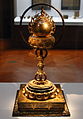
Container for Buddhist Relics in Shape of Flaming Sacred Precious stone
Symbolic physical attributes [edit]

Two Burmese Buddhist monks

Tibetan Buddhists with prayer beads (mala)
Buddhist textile and visual culture as well equally ritual tools (such as robes and bells) have oftentimes adult diverse symbolic meanings which are usually shared by Buddhist sects around the earth.
Robes and alopecia [edit]
The fashion and design of the robes of a monastic oftentimes indicate the sect of Buddhism, tradition or country, they vest to. In most Buddhist cultures, the Buddhist monastic robe represents a renunciant monastic. Different traditions, sects of Buddhism (and different countries) will accept robes of dissimilar colors as well equally different styles or ways on how they wear it. Once Buddhism spread throughout China back in sixth century BCE,[25] it was seen wrong to bear witness that much skin, and that's when robes to cover both artillery with long sleeves came in to play.[26] In Tibet, it accept changed over time and they testify both their shoulders besides as having a two piece attire rather than one. Shortly thereafter, Japan integrated a bib along with their long sleeve robe called a koromo. This was a clothing slice made specifically for their school of Zen which they practice in Takahatsu that involves the monks of Nihon wearing a straw hat.[27]
Shaving ones head is another ritual and symbolic act most Buddhist monastics consummate before inbound a monastic guild. To shave ones head merely signifies ones readiness to enter into the monastic path and abandon the worldly life.[28] [29]
Tools [edit]
Buddhist monks traditionally acquit a begging bowl, and this is some other common symbol of Buddhist monastics around the globe (even though not all modern Buddhist traditions make use of the traditional do of begging for one's nutrient).
In all sects of Buddhism, bells are frequently used to signify the start of rituals or to mark time.[30] They use the bell to detain away the bad spirits and take the Buddha protect them at the time of their ritual. Some sects telephone call this a part of the "Mystic Law" which is the beginning of a Buddhist ritual.[31] Other ritual tools include drums, wooden fish, trumpets, the keisaku, and the tantric the vajra and bell.
Physical gestures [edit]
Another form of symbolism of the Buddhist is the joining of your hands together at prayer or at the fourth dimension of the ritual (añjali mudrā).[32] Buddhist compare their fingers with the petals of the lotus flower. Bowing down is some other form of symbolic position in the human action of the ritual, when Buddhist bow in forepart of the Buddha or to some other person they aren't bowing at the concrete (the human or the statue) simply they are bowing at the Buddha inside of them (the human) or it (the statue).[33]
Notable symbols [edit]

Buddhist flag [edit]
The five-colored flag accept been designed in Sri Lanka in the 1880s with the aid of Henry Steel Olcott. The half dozen vertical bands of the flag represent the six colors of the aura which Buddhists believe emanated from the torso of the Buddha when he attained Enlightenment.[34] [35] [36] [37]
Dharma wheel [edit]
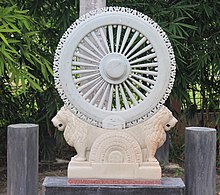
A Dharma Wheel with a lotus half-roundel and lion base, from Amaravati.
The Dharma wheel (dharma-chakra) is one of the primeval Buddhist symbols. It is an ancient Indian symbol of sovereignty and auspiciousness (equally well as the sun god Surya) which pre-dates Buddhism and was adopted by early on Buddhists.[38] Information technology appears in early Buddhist sites such as Sanchi and Bharhut, where information technology is a symbol of the Buddha himself. The Dharma cycle also represents the Dharma (Buddha'due south instruction, the ultimate truth).[39] [40] [41] The main idea of this symbol is that the Buddha was seen equally a person who "turned the wheel", which signifies a not bad and revolutionary moment in history (i.east. the teaching of the Buddha'southward Dharma at Varanasi). While the Buddha could accept become a nifty male monarch, he instead chose to become a great sage.[42] [43] [38] Illustrations from early Buddhist sites every bit well every bit Buddhist texts like the Mahavamsa, indicate that the worship of Dharma wheels on pillars ("bicycle pillars", cakrastambha) was a common exercise in early Buddhism.[44]
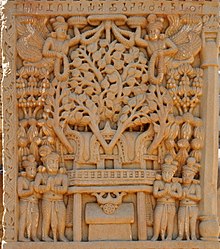
Bodhi tree from Sanchi complex topped with a chatra (royal umbrella)
The Dharma wheel is thus also a royal symbol, indicating a male monarch who is a chakravartin ("Turner of the Bicycle").[38] In the Buddhist scriptures, information technology is described every bit a royal treasure of great, world grade kings, a perfect wheel with a m spokes.[45] Because of this, it was thus also used by the Mauryans, especially Ashoka (in the Pillars of Ashoka).[46] According to Karlsson "the association between the numbers of the spokes and a special Buddhist doctrine is a subsequently estimation and not present in early Buddhist art." Early Buddhist depictions contain wheels with various number of spokes (viii, 16, 20, 25 and 32).[47]
Bodhi tree [edit]
The Bodhi Tree (Pali: bodhirukka) was a ficus (ficus religiosa) which stood is on the spot where the Buddha reached awakening ("bodhi"), called the bodhimanda (place of awakening). This tree has been venerated since early Buddhist times and a shrine was built for information technology. Offerings to the Buddha were offered to the tree.[48] The Bodhi tree (ofttimes paired with an empty seat or āsana) thus represents the Buddha himself, as well every bit liberation and nirvana.[49] Branches and saplings from the Bodhi tree were sent to other regions as well. It is said that when the Buddha was born, the Bodhi tree sprung up on the bodhimanda at the aforementioned time.[48] The worship of trees is an aboriginal Indian custom which tin be found equally far back every bit in the Indus Valley Civilisation.[50]
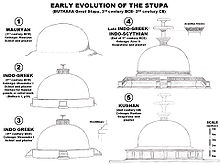
The development of the Butkara Stupa; notation the addition of more elaborate chatras (royal umbrella)
Stupa [edit]
Stūpas (literally "heap") are domed structures which may derive from ancient Indian funerary mounds.[51] The earliest Buddhist stupas are from near the 3rd century BCE.[52] In the early Buddhist texts, the Buddha's bodily relics (śarīra, the basic leftover from cremation) were said to have been placed in diverse stūpas and therefore, Buddhist stūpas are generally symbolic of the Buddha himself, specially his passing abroad (final nirvana).[53] [54] [55] It may even have been a belief of some early Buddhists that the presence of the Buddha or the Buddha's power could be found in a stūpa.[56]
Other relics belonging to the Buddha's disciples were also enclosed in caskets and placed in stupas. Caskets with relics of Sariputta and Moggallana were establish in Sanchi stupa number iii, while stupa number 2 contains a casket with relics from ten monks (according to inscriptions).[57] Stūpa were venerated by Buddhists, with offerings of flowers and the similar.[58]
Initially, Buddhist stūpas were simple domes which developed more than elaborate and complex forms in later periods.[59] Over fourth dimension, the style and design of the stūpa evolved into unique and distinct regional styles (such equally Asian pagodas and Tibetan chortens).
Animals [edit]
King of beasts [edit]

Snow Lion, one of the types of Lions in Buddha symbolism.
Early on Buddhist art contains various animals. These include lions, nāgas, horses, elephants, and deer. Most of these are often symbolic of the Buddha himself (and some are epithets of the Buddha), though they may also be depicted as simply decorative illustrations depending on context. According to Jampa Choskyi, while the animals are considered to be symbols for the Buddha, lions are the symbols of the bodhisattvas or besides known as the sons of the Buddha.[60] Though the lion, is a symbol of royalty, sovereignty, and protection, is used every bit a symbol for the Buddha, who is also known as the "lion of the Shakyas". Buddha's teachings are referred to as the "Lion'south Roar" (sihanada) in the sutras, which symbolizes the supremacy of the Buddha'south teaching over all other spiritual teachings. When looking at the shrines on the iconography, the lions symbolize another function, which they are considered the bodhisattvas who tin can be seen as the sons of the Buddha. [threescore]
Elephant [edit]

Tibetan painting of a Buddhist elephant
The Buddha was also symbolized by a white elephant, another Indian symbol of regal ability. This symbol appears in the myth of Queen Maya when the Buddha takes the grade of a white elephant to enter his mother'southward womb. Though the characteristics that are emphasized are the animal'southward strength and steadfastness, these are the ones that become the symbol for the individual's mental and physical strength. The other way that the elephant is besides a symbol of responsibility and earthiness.[sixty] When looking at the myth in India about elephants, the way that the myth goes is that the Airavata and the flying elephants would be used every bit a vehicle for transportation. The elephant was said to be seen seemingly emerging from the white ocean, these animals were seen equally having special powers with ane beingness the ability to produce pelting.[threescore] Not only, were they considered to accept the power to produce rain, in Indian society, but they were too are a symbol of good luck and prosperity, and since they were Kings would own them and fifty-fifty used them in wars.[60] The white elephant can also be seen as a symbol of mental force, the elephant would start as a gray elephant that is rampant when the mind is uncontrollable. As the individual continues to practice dharma and tin can tame their mind, the gray elephant now becomes a white one, which is a symbol for strong and powerful, who merely destroys in the directions that are willed past the individual. The tusks are also seen as an emblem of the Seven Majestic Emblems. However, Gangpati or Ganesh is known to be an elephant-faced deity which is a form of the bodhisattva of Avalokitesvara. While, the elephant is seen as a deity when in the form of Avalokitesvara, the fauna has used transportation for Tathagata Aksobhya and the deity Balabadra. Like the lion, the elephant is seen every bit a guardian of temples and the Buddha. [60]
Horse [edit]

Some of the characteristics that are emphasized near the horse are their loyalty, industriousness. and swiftness. [threescore]These characteristics can be seen in the riderless horse (representing the Buddha'southward royal horse, Kanthaka) symbolizes the Buddha's renunciation, and can be seen in some depictions of the "Keen Renunciation" scene (along with Chandaka, the Buddha'south attendant holding up a royal umbrella). Meanwhile, deer stand for Buddhist disciples, every bit the Buddha gave his kickoff sermon at the deer park of Varanasi. In terms of Buddhism, the horse is a symbol of energy and effort when practicing dharma, along with the air or Prana that volition run through the channels of the body. The "Wind Horse" is the transportation of the mind and can be ridden on. The deity that is associated with the horse is Lokesvara too known equally Avalokitesvara, who also takes the form of a horse. When looking at Buddhist iconography, the horse is seen supporting the throne of Tathagatha Ratnasambhava. While they are used for back up for Tathagatha Ratnasambhava, the animal is used every bit transportation for deities and dharma protectors, known as Mahali and the equus caballus-faced deities, an example of this is Hayagriva.[60]
Naga [edit]
The Buddha is too often called a "great nāga" in the sutras, which is a mythical serpent-like being with magical powers. However, this term is likewise generally indicative of the greatness and magical power of the Buddha, whose psychic power (siddhi) is greater than that of all gods (devas), nature spirits (yakkha), or nāgas. Some other important nāga is Mucalinda, rex of the nāgas, who is known for having protected the Buddha from storms.
Peacock [edit]

The peacock has multiple distinctly different symbols for which it is considered in different parts of the earth and religions; nevertheless, in Buddhism, the peacock is a symbol of wisdom. The way they are connected to the bodhisattvas is by the peacock's power to swallow a poisonous establish without getting affected by the establish, which correlates with the bodhisattva'south path toward enlightenment. The bodhisattva'southward path begins with delusions, ignorance, desire, lastly hatred, which all can be translated into moha, raga, dvesa. The opening of the colorful tail of the peacock tin be compared to the enlightenment of the bodhisattva. The tradition that comes with the symbol of the peacock is when the bodhisattva becomes enlightened. The bodhisattva's torso is adorned with five brightly colored feathers (red, blueish, dark-green, and others) that tin be seen on the body. During the ceremony, the bodhisattva eats the same poisonous plants as the peacock, as information technology happens, the feathers slowly change colors since, like the peacock, these individuals are not worried nearly the damage that may come to them. Essentially the peacock is a symbol of the change from the path of desire to the path of liberation. The deities that are associated with the peacock is Amitabha, who happens to represent desire and zipper into changes into liberation. [lx] Forth with the peacock being a symbol in Buddhism, birds as a whole can exist seen to be apart of the mantra said during "Wheel of Law", which has "Aum or Om Mani Padme Hung or hum rhi" as the individual symbols. When said together, the translation of the mantra is "Adoration to the jewel in the Lotus Amen". According to Tseten Namgyal. states that the symbols represented as "Om corresponding angels, Mani representing demons, Padme as men, hum as quadrupeds srhi as birds and reptiles".[61]
Garuda [edit]

Garuda vanquishing the Naga clan, a Gandhara artwork, second century CE.
Garuda is also known equally the king of the birds. When looking at the origins of the name it comes from Gri meaning to consume since he devours snakes. The way he is represented in iconographies, he can either be seen with the upper body of a man, that has big eyes, a beak, short blue horns, yellowish hair standing on the cease, a bird'southward claws and wings. In Hinduism, he can be represented as a human with wings. However, when looking at the symbolism of Garuda, it represents the space chemical element and the power of the lord's day. Though when looking at the representation from a spiritual view, Garuda represents the spiritual energy that will devour the delusions from jealousy and hatred (represented by snakes). Since he represents the space element, this includes the openness that tin exist seen when he stretches his wings. Though, when looking at Buddhism specifically, he tin represent the dana paramita, when the sun's rays give life to the earth. The deity that Garuda is associated with is Amoghasiddhi, which is the vehicle of the deity. Through this, he is also the vehicle form of Lokishvara Hariharihar vahana. Nevertheless, he is a deity of his own, who is said to exist able to cure the bites of snakes, epilepsy, and diseases acquired by nagas. Garuda tin be found in toranas which are the semicircular tympanum that stands above the temple doors. Along with an emerald that happens to be named Garuda rock which is said to be protection confronting poison. Images of the deity are on jewelry as protection against the bites of snakes.[lx]
Prevention of killing animals in Japan [edit]
During the early days in Japan, some places in the country would there were some places in the country that would allow the killing of animals in the region. Still, Buddhism was transmitted to the country by China via the Korean peninsula. One of the teachings that resonated with the Japanese people was the bones laws of Buddhist ethics that had a part of the laws included the commandment to not kill which was like to the principle of benevolence or jin, 仁. And so from the 7th century onwards, the rulers would prohibit the killing of animals since the animals would exist a symbol of benevolent rule for these rulers. What this meant for the animals that were kept by imperial officials included dogs, falcons, and cormorants to proper noun a few who were used for hunting purposes were to be set free. Their offices one time used for hunting were abolished later on and the personnel who worked there would exist transferred. Though the longevity of these decrees did not concluding long, the decrees had a long-lasting effect on the norms, values, and behavior of at least the upper class of Japanese society for the next several hundred years. [62]
Lotus [edit]

Lotus and triratna at Sanchi
The Indian lotus (Nelumbo nucifera, Sanskrit: padma) is an aboriginal symbol of purity, disengagement and fertility, and it is used in various Indian religions.[63] In Buddhism, the lotus is too some other symbol for the Buddha and his awakening. In the Buddhist scriptures, the Buddha compares himself to a lotus (in Pali, paduma). Merely like the lotus flower comes up from the muddy water unstained, the Buddha is said to transcend the world without stains.[64] [65] [63] The Indian lotus as well appears in early on Buddhist sites like Sanchi and Bharhut. Information technology is also the specific symbol of Amitabha, the Buddha of the Lotus family, as well equally Avalokiteshvara (i.e. Padmapani, the "lotus holder"). In Tantric Buddhism, it is also symbolic for the vagina equally well as for chakras (often visualized every bit lotuses).

Triratna [edit]
Another early on symbol is the triratna ("three jewels"), too called a trident (trishula) in not-Buddhist contexts. According to Karlsson, the ancient pre-Buddhist symbol was initially seen as a "weapon against enemies or Evil."[66] In Buddhism, this symbol after came to represent the Buddha, Dharma (didactics, eternal police), and sangha (Buddhist monastic community).[66]
Vajrasana [edit]
The Buddha throne, or empty seat/platform (āsana, later associated with the "vajra seat", vajrāsana) is a symbol of the Buddha. The vajra seat or enkindling seat represents the place where he sat downward (in Bodh Gaya) to meditate and attained awakening. Information technology thus likewise represents the place of awakening (bodhimanda) and is thus similar to the Bodhi tree in this regard.[67] [68] [69] In early Buddhist art, the vajra seat may as well be depicted as an empty seat (ofttimes under a tree) or a platform. However, these seats or platforms may not specifically symbolize the "vajra seat" itself and may just be an altar or a symbol of the Buddha.[70] A vajra seat or empty seat may as well be decorated with lotuses or exist depicted as a giant lotus (in this case, it can be referred to as a "lotus throne").

The Emerald Buddha; note the elaborate umbrella (chatra) decorated with Bodhi leaves and the lotus throne
Footprints [edit]

Buddha footprint at the entrance of the Seema Malaka temple, Sri Lanka.
The Buddha footprint (buddhapāda) represents the Buddha. These footprints were often placed on stone slabs, and are commonly decorated with some other Buddhist symbol, such every bit a Dharma wheel, swastika, or triratna, indicating Buddhist identity.[71] [72] Co-ordinate to Karlsson, "in the 3rd century AD as many every bit twelve signs tin can be seen on slabs from Nagarjunakonda. At that fourth dimension nosotros tin found such signs as fishes, stupas, pillars, flowers, urns of plenty (purnaghata) and mollusc shells engraved on the buddhapada slab".[73]
Chhatra [edit]

The Buddha as a flaming colonnade, Amaravati, Satavahana catamenia
In some early reliefs, the Buddha is represented by a majestic umbrella (chatra). Sometimes the chatra is depicted over an empty seat or a horse, and it is sometimes held by an attendant figure similar Chandaka. In other depictions, the chatra is shown over an illustration of the Buddha himself.[74] It as well represents royalty and protection, also as laurels and respect.
Indrakhila [edit]
The Indrakhila ("Indras post") which appears in early Buddhist sites has sometimes been interpreted every bit a symbol for the Buddha (just it could simply be a symbol of auspiciousness). This is normally "a series of formalized lotus plants one above the other, with artificial brackets in the borders from which hang jewelled garlands and necklaces of lucky talismans betokening both worldly and spiritual riches. At the top there is a trident and at the bottom a pair of footprints".[75]
Flaming colonnade [edit]
Another symbol which may indicate the Buddha is a "flaming pillar".[76] This may be a reference to the Twin Miracle at Savatthi and the Buddha's magical abilities.
Swastika [edit]


Countless knot in a Burmese Pali Manuscript
The svastika was traditionally used in Bharat to represent expert fortune. This symbol was adopted to symbolize the auspiciousness of the Buddha.[77] The left-facing svastika is oft imprinted on the breast, anxiety or palms of Buddha images.[78] The swastika was also a symbol of protection from evil.[79] The ancient swastika (which are also Chinese characters, mainly 卍 and 卐) is common in Buddhist art. It is widely used in East asia to represent Buddhism, and Buddhist temples. Buddhist symbols like the swastika take too been used as a family emblem (mon) by Japanese clans.[eighty]
Endless knot [edit]
The endless knot is a symbol of good luck. Information technology may likewise correspond dependent origination.
Pair of fishes [edit]
A pair of fishes (Sanskrit: matsyayugma) represent happiness and spontaneity as well as fertility and abundance. In Tantric Buddhism, it represents the left and right subtle body channels (nadis). In China, it often represents fidelity and conjugal unity.
Dhvaja [edit]

The victory imprint was a armed forces symbol of victory, and symbolizes the Buddha'due south victory over Mara and the defilements (an epithet for the Buddha is the "conquistador"; in Sanskrit, Jina).
Vase [edit]

A treasure vase, which represents inexhaustible treasure and wealth, is besides an attribute of wealth deities like Jambhala, Vaishravana and Vasudhara.
Conch vanquish [edit]
A conch crush represents victory, the spreading the teachings of the Buddha far and broad, and the aspect of speech. Information technology is diddled on auspicious events to announce (and also invite) the deities or other living beings of the happening of the auspicious outcome, such equally marriages (in Sri Lanka).
E'er-burning lamp [edit]
The "ever-called-for lamp" (changmingdeng) is "an oil lamp kept in the monastery that in theory was never immune to fire out". This was used as a symbol for the Buddhist teachings and for the "mind of correct enlightenment" (zhengjuexin).
Ruyi [edit]
Ruyi may accept been used as a billy held by a speaker in a conversation (a talking stick), and after became imbued with different Buddhist meanings.
Wooden fish [edit]

A Japanese "wooden fish" (mokugyo), a wooden percussion instrument used in chanting
Wooden fish symbolized vigilance.

Tibetan ritual conch shell trumpet with dragon

Votive lamps from a Taiwanese temple
Ring staff [edit]
The ring staff is traditionally said to exist useful in alerting nearby animals as well as alerting Buddhist donors of the monk's presence (and thus is a symbol of the Buddhist monk).
Number 108 [edit]
The number 108 is very sacred in Buddhism. Information technology represents 108 kleshas of humankind to overcome in lodge to achieve enlightenment. In Japan, at the end of the year, a bong is chimed 108 times in Buddhist temples to finish the sometime year and welcome the new one. Each ring represents one of 108 earthly temptations (Bonnō) a person must overcome to achieve nirvana.
Vajra [edit]

A vajra is a ritual weapon symbolizing the properties of a diamond (indestructibility) and a thunderbolt (irresistible force). The vajra is a male polysemic symbol that represents many things for the tantrika. The vajra is representative of upaya (skilful means) whereas its companion tool, the bell which is a female person symbol, denotes prajna (wisdom). Some deities are shown holding each the vajra and bell in separate hands, symbolizing the matrimony of the forces of compassion and wisdom, respectively.
In the tantric traditions of Buddhism, the vajra is a symbol for the nature of reality, or sunyata, indicating endless creativity, dominance, and proficient activity.
An instrument symbolizing vajra is likewise extensively used in the rituals of the tantra. It consists of a spherical central section, with ii symmetrical sets of 5 prongs, which arc out from lotus blooms on either side of the sphere and come up to a point at two points equidistant from the centre, thus giving it the appearance of a "diamond sceptre", which is how the term is sometimes translated.
Diverse figures in Tantric iconography are represented belongings or wielding the vajra.
The vajra is made upwardly of several parts. In the center is a sphere which represents Sunyata, the primordial nature of the universe, the underlying unity of all things. Emerging from the sphere are ii viii petaled lotus flowers. 1 represents the phenomenal world (or in Buddhist terms Samsara), the other represents the noumenal globe (Nirvana). This is one of the fundamental dichotomies which are perceived past the unenlightened.
Arranged equally around the mouth of the lotus are two, four, or 8 creatures which are called makara. These are mythological half-fish, half-crocodile creatures made up of 2 or more animals, often representing the union of opposites (or a harmonisation of qualities that transcend our usual feel). From the mouths of the makara come tongues which come together in a point.
The five-pronged vajra (with iv makara, plus a fundamental prong) is the most commonly seen vajra. There is an elaborate system of correspondences betwixt the v elements of the noumenal side of the vajra, and the phenomenal side. One important correspondence is between the v "poisons" with the v wisdoms. The 5 poisons are the mental states that obscure the original purity of a beingness'southward heed, while the 5 wisdoms are the five most important aspects of the enlightened heed. Each of the 5 wisdoms is likewise associated with a Buddha effigy (see also Five Wisdom Buddhas).
Bong [edit]
The vajra is almost always paired with a ritual bell. Tibetan term for a ritual bell used in Buddhist religious practices is tribu. Priests and devotees band bells during the rituals. Together these ritual implements represent the inseparability of wisdom and compassion in the enlightened mindstream. During meditation ringing the bell represents the sound of Buddha educational activity the dharma and symbolizes the attainment of wisdom and the agreement of emptiness. During the chanting of the mantras the Bell and Vajra are used together in a variety of unlike ritualistic ways to represent the union of the male and female principles.
The hollow of the bell represents the void from which all phenomena arise, including the audio of the bong, and the clapper represents form. Together they symbolize wisdom (emptiness) and compassion (form or advent). The sound, like all phenomena, arises, radiates forth so dissolves back into emptiness.
Enso [edit]
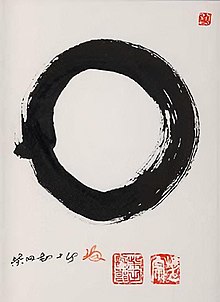
Ensō Calligraphy by Kanjuro Shibata Twenty
In Zen, ensō (円相, "round form") is a circumvolve that is hand-fatigued in i or two uninhibited brushstrokes to express a moment when the mind is free to let the trunk create.The ensō symbolizes absolute enlightenment, strength, elegance, the universe, and mu (the void). It is characterised by a minimalism built-in of Japanese aesthetics.The circle may be open or closed. In the onetime case, the circle is incomplete, allowing for motion and development as well equally the perfection of all things. Zen practitioners relate the idea to wabi-sabi, the beauty of imperfection. When the circle is airtight, it represents perfection, akin to Plato's perfect grade, the reason why the circle was used for centuries in the construction of cosmological models Once the ensō is fatigued, one does not change it. It evidences the graphic symbol of its creator and the context of its creation in a brief, continuous period of time. Ensō exemplifies the diverse dimensions of the Japanese wabi-sabi perspective and artful: fukinsei (asymmetry, irregularity), kanso (simplicity), koko (basic; weathered), shizen (without pretense; natural), yugen (subtly profound grace), datsuzoku (freedom), and seijaku (tranquility).
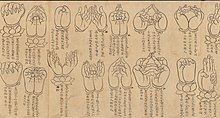
Japanese curlicue depicting various mudras
Mudras [edit]
Mudras are a serial of symbolic hand gestures in Buddhist art. In that location are numerous mudras with different meanings. Mudras are used stand for specific moments in the life of Gautama Buddha.
Other symbols [edit]
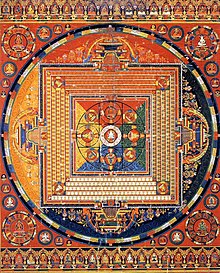
Mandala of Vajradhatu (the vajra realm)
- Some deities such as Prajñaparamita and Manjushri are depicted equally property a flaming sword, symbolizing the power of wisdom (prajña).
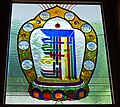
- The gankyil or "bicycle of joy" symbol, which tin can symbolize different sets of three ideas.
- Various kinds of jewels (mani, ratna), such as the cintamani or "wish fulfilling jewel".[81]
- Buddhist prayer beads (mala), which originated in Republic of india as a manner to count prayers or mantras and commonly take 108 chaplet.[82]
- The wish fulfilling tree (kalpavriksha)
- The fly-whisk, which is a tool to drive away insects and thus symbolizes non-harming (ahimsa).[83]
- Mandala, Yantra.
Groups [edit]

A Chinese Metal Cup stand with the viii auspicious symbols (14th century)
The 8 auspicious signs [edit]
Mahayana Buddhist art makes use of a mutual fix of Indian "eight cheering symbols" (Sanskrit aṣṭamaṅgala, Chinese: 八吉祥; pinyin: Bā jíxiáng , Tib. bkra-shis rtags-brgyad). These symbols were pre-Buddhist Indian symbols which were associated with kingship and may originally have included other symbols, like the swastika, the srivasta, a throne, a drum and a flywisk (this is still part of the Newari Buddhist eight symbol list).[84]
The virtually common set of "Viii Auspicious Symbols" (used in Tibetan and East Asian Buddhism) are:[85] [86]


- Lotus blossom (Skt. padma; Pali. Paduma)
- Endless knot (srivasta, granthi) or "curl of happiness" (nandyavarta)
- Pair of golden fish (Skt. matsyayugma)
- Victory banner (Skt. dhvaja; Pali. dhaja)
- Dharma wheel (Skt. Dharmacakra Pali. Dhammacakka)
- Treasure vase (kumbha)
- Jeweled Parasol (Skt. chatra; Pali. Chatta)
- White Conch Crush (sankha)
Symbols on Feet of Buddha [edit]
Buddha footprints ofttimes bear distinguishing marks, such as a Dharmachakra at the centre of the sole, or the grouping of 32, 108 or 132 auspicious signs of the Buddha, engraved or painted on the sole.
Meet too [edit]
- Buddhist art
- Chinese art
- Indian art
- Japanese art
- Korean art
- Religious symbolism
- Tibetan art
References [edit]
- ^ a b Coomaraswamy (1998), pp. one–v.
- ^ Karlsson (2000), p. 168.
- ^ Karlsson, Klemens. Confront to face with the absent Buddha: The formation of Buddhist Aniconic art. Diss. Acta Universitatis Upsaliensis, 2000.[1]
- ^ Freiberger, Oliver. "The Meeting of Traditions: Inter-Buddhist and Inter-Religious Relations in the West". Archived from the original on 2004-06-26. Retrieved 2004-07-15 .
- ^ Chauley (1998), p. iv.
- ^ a b Karlsson (2000), p. 11.
- ^ Karlsson (2000), p. 174.
- ^ a b Chauley, G. C. (1998) pp. ane–xvi.
- ^ "The Fine art of Buddhism". The Freer Gallery of Fine art and Arthur M. Sackler Gallery. Smithsonian Establishment. 2008. Retrieved 29 September 2014.
- ^ Prapod Assavavirulhakarn (1990). The Ascendency of Theravada Buddhism in Southeast Asia, p. 133. University of California, Berkeley.
- ^ Kieschnick (2020), p. 85.
- ^ Kieschnick (2020), pp. 100, 113–115, 138–139, 153.
- ^ Williams, Charles Alfred Speed (2006). Chinese Symbolism and Art Motifs: A Comprehensive Handbook on Symbolism in Chinese Fine art through the Ages, p. 170. Tuttle Publishing.
- ^ Williams, Charles Alfred Speed (2006). Chinese Symbolism and Art Motifs: A Comprehensive Handbook on Symbolism in Chinese Art through the Ages, pp. 83–87. Tuttle Publishing.
- ^ Prasetyo, Lery (2019-08-01). "THE SPIRITUAL AND CULTURAL SYMBOLS IN A MAHAYANA BUDDHIST TEMPLE 'VIHARA LOTUS' SURAKARTA". Analisa: Periodical of Social Science and Organized religion. iv (1): 59–78. doi:x.18784/analisa.v4i01.788. ISSN 2621-7120.
- ^ Kieschnick (2020), p. 83.
- ^ see for example: Ensō: Audrey Yoshiko Seo (2007). Zen Circles of Enlightenment. Shambhala Publications.
- ^ Beer (2003), p. 87.
- ^ Beer (2003), p. 92.
- ^ Beer (2003), p. 95.
- ^ Beer (2003), pp. 98–112.
- ^ a b c d east Sangharakshita. An Introduction to Tibetan Buddhism.
- ^ "Tibet Travel". Retrieved 26 August 2015.
- ^ "Shakya Statues". Retrieved 27 Aug 2015.
- ^ "Buddhism in Cathay". Asia Society . Retrieved 2018-10-28 .
- ^ "Get an Overview of the Robes Worn by Buddhist Monks and Nuns". ThoughtCo . Retrieved 2018-x-28 .
- ^ "Buddhist Monks' Robes: An Illustrated Guide". ThoughtCo . Retrieved 2018-10-11 .
- ^ "Why do Buddhists Shave their Heads?". www.chomonhouse.org . Retrieved 2018-ten-12 .
- ^ "Why practice Buddhist monks and nuns shave their heads? – Mahamevnawa Buddhist Monastery". Mahamevnawa Buddhist Monastery. 2018-04-20. Archived from the original on 2018-10-28. Retrieved 2018-10-28 .
- ^ "Buddhist Bells and Statues – Presentation | Art in the Modern Earth 2014". blogs.cornell.edu . Retrieved 2018-10-28 .
- ^ "The Meaning of Burning Incense and Ringing Bells in Buddhism | Synonym". Retrieved 2018-10-11 .
- ^ "Why Buddhists Join Their Easily in Prayer | Myosenji Buddhist Temple". nstmyosenji.org . Retrieved 2018-10-12 .
- ^ 본엄 (2015-06-07), Why Practise Buddhists Bow to Buddhas?, archived from the original on 2021-12-12, retrieved 2018-10-12
- ^ "Archived copy". Archived from the original on 2004-09-23. Retrieved 2004-07-15 .
{{cite web}}: CS1 maint: archived re-create as championship (link) - ^ Wayman, Alex. "The Mirror every bit a Pan-Buddhist Metaphor-Simile." History of Religions thirteen, no. 4 (1974): 251–269.
- ^ "The Buddhist Flag". Buddhanet. Retrieved 2 Apr 2015.
- ^ "The Origin and Significant of the Buddhist Flag". The Buddhist Council of Queensland. Retrieved 2 Apr 2015.
- ^ a b c Karlsson (2000), pp. 160, 164.
- ^ Chauley, 1000. C. (1998) pp. one–20.
- ^ T. B. Karunaratne (1969), The Buddhist Bike Symbol, The Wheel Publication No. 137/138, Buddhist Publication Society, Kandy • Sri Lanka.
- ^ John C. Huntington, Dina Bangdel, The Circle of Bliss: Buddhist Meditational Fine art, p. 524.
- ^ Pal, Pratapaditya (1986), Indian Sculpture: Circa 500 B.C.–A.D. 700, p. 42. University of California Printing
- ^ Ludowyk, E.F.C. (2013) The Footprint of the Buddha, Routledge, p. 22.
- ^ Karlsson (2000), p. 161.
- ^ T. B. Karunaratne (1969), The Buddhist Wheel Symbol, The Cycle Publication No. 137/138, Buddhist Publication Society, Kandy • Sri Lanka.
- ^ Chauley, Chiliad. C. (1998) pp. 1–20.
- ^ Karlsson (2000), p. 162.
- ^ a b G.P. Malalasekera (2003) Dictionary of Pali Proper Names, Book 1, pp. 319–321. Asian Educational Services.
- ^ Karlsson (2000), pp. 98–102.
- ^ Karlsson (2000), p. 158.
- ^ Karlsson (2000), p. 175.
- ^ Karlsson (2000), p. 175.
- ^ Encyclopædia Britannica (2008), Pagoda.
- ^ Buddhist Compages, Lee Huu Phuoc, Grafikol 2009, p.140-174
- ^ Karlsson (2000), pp. 164–165, 174–175.
- ^ Karlsson (2000), pp. 183–184.
- ^ Karlsson (2000), p. 181.
- ^ Karlsson (2000), p. 182.
- ^ Lee Huu Phuoc (2009). Buddhist Architecture, p.149-150, Grafikol
- ^ a b c d eastward f g h i j Choskyi, Jampa (1988). "Symbolism of Animals in Buddhism". Gakken Co. Archived from the original on 2017-04-15. Retrieved 15 Oct 2021.
- ^ Namgya, Tseten (2016). "Significance of 'Viii Traditional Tibetan Buddhist Cheering Symbols /Emblems' (bkra shis rtags brgyad) in mean solar day to twenty-four hours Rite and Rituals". EBSCOhost . Retrieved fifteen October 2021.
{{cite web}}: CS1 maint: url-status (link) - ^ Vollmer, Klaus (2006). "Buddhism and Violence" (PDF). The Lumbini International Inquiry Institute. Archived (PDF) from the original on 2020-09-xx. Retrieved 15 October 2021.
- ^ a b Karlsson (2000), pp. 165–166.
- ^ AN ten.81, '"Bāhuna suttaṃ".
- ^ AN 4.36, "Doṇa suttaṃ".
- ^ a b Karlsson (2000), p. 168.
- ^ Ching, Francis D. One thousand.; Jarzombek, Mark M.; Vikramaditya Prakash (2017). A Global History of Architecture, p. 570. John Wiley & Sons.
- ^ Huu Phuoc Le. Buddhist Architecture, p.240
- ^ Buswell Jr., Robert Due east.; Lopez Jr., Donald S. (2013). The Princeton Dictionary of Buddhism, "Bodhimanda". Princeton: Princeton Academy Press. ISBN 9781400848058.
- ^ Karlsson (2000), p. 166.
- ^ "Footprints of the Buddha". Buddha Dharma Education Association Inc. 2008. Retrieved 2008-05-11 .
- ^ Stratton, Ballad (2003). Buddhist Sculpture of Northern Thailand, p. 301. Serindia Publications. ISBN one-932476-09-1.
- ^ Karlsson (2000), p. 158.
- ^ Marshall, John. "A Guide to Sanchi", p. 31.
- ^ Karlsson (2000), pp. 100–102.
- ^ Karlsson (2000), pp. 48, 120.
- ^ Swastika: SYMBOL, Encyclopædia Britannica (2017)
- ^ Adrian Snodgrass (1992). The Symbolism of the Stupa. Motilal Banarsidass. pp. 82–83. ISBN 978-81-208-0781-v.
- ^ Karlsson (2000), p. 169.
- ^ (Japanese) Hitoshi Takazawa, Encyclopedia of Kamon, Tōkyōdō Shuppan, 2008. ISBN 978-iv-490-10738-8.
- ^ Williams, Charles Alfred Speed (2006). Chinese Symbolism and Art Motifs: A Comprehensive Handbook on Symbolism in Chinese Art through the Ages, p. 413. Tuttle Publishing.
- ^ Kieschnick (2020), pp. 116–124.
- ^ Williams, Charles Alfred Speed (2006). Chinese Symbolism and Art Motifs: A Comprehensive Handbook on Symbolism in Chinese Art through the Ages, p. 201. Tuttle Publishing.
- ^ Beer (2003), p. i.
- ^ Beer (2003), pp. 1–14.
- ^ Zhou Lili. "A Summary of Porcelains' Religious and Auspicious Designs." The Bulletin of the Shanghai Museum 7 (1996), p.133
Bibliography [edit]
- Anderson, Carol (2013-x-11). Pain and Its Ending. doi:x.4324/9781315027401. ISBN9781136813252.
- Beer, Robert (2003). The Handbook of Tibetan Buddhist Symbols. Serindia Publications. ISBN978-one-932476-03-iii.
- Coomaraswamy, Ananda K. (1998). Elements of Buddhist Iconography. Munshiram Manoharlal Publishers.
- Chauley, G. C. (1998). Early Buddhist Art in India: 300 B.C. to 300 A.D. Sundeep Prakashan
- Kapstein, Matthew T. (June 2004). "Tadeusz Skorupski: The Buddhist Forum, Volume 6. 9, 269 pp. Tring: The Plant of Buddhist Studies, 2001". Bulletin of the School of Oriental and African Studies. 67 (2): 266. doi:10.1017/s0041977x04420163. ISSN 0041-977X. S2CID 162316190.
- Karlsson, Klemens (2000). Face to Face With the Absent Buddha - The Formation of Buddhist Aniconic Art. Uppsala University.Lokesh, C., & International University of Indian Civilization. (1999). Dictionary of Buddhist iconography. New Delhi: International University of Indian Culture.
- Seckel, Dietrich; Leisinger, Andreas (2004). Earlier and across the Image: Aniconic Symbolism in Buddhist Fine art, Artibus Asiae, Supplementum 45, 3–107
- Xing, Guang (2004-eleven-x). The Concept of the Buddha. doi:10.4324/9780203413104. ISBN9781134317004.
- Kieschnick, John (2020). The Touch of Buddhism on Chinese Fabric Civilisation. Princeton University Printing.
External links [edit]
- Sacred Visions: Early Paintings from Central Tibet, an exhibition catalog from The Metropolitan Museum of Art (fully available online as PDF), which contains fabric on Buddhist symbolism
- spider web site showing iconic representations of the eight auspicious symbols forth with explanations
- the eight auspicious symbols of Buddhism — a study in spiritual evolution
- General Buddhist Symbols
- Tibetan Buddhist Symbols
- Buddhist Tantric Symbols
- Buddhist Symbols: the Eight Cheering Signs
Source: https://en.wikipedia.org/wiki/Buddhist_symbolism
0 Response to "In Art the Buddha Is Typically Portrayed With Both Masculine and Feminine Qualities"
Post a Comment